quantum inspire 2025
Following the 2024 collaboration with Waag Futurelab, the 2025 edition of Quantum Inspire shifted toward a more focused educational goal:
Designing interactive experiences that help HBO (Dutch university of applied sciences) students understand quantum computing through interactive experiences.
While the previous year explored broad public engagement, this iteration aimed to improve clarity, research validity, and measurable learning outcomes.
*This version only contains projects from 2025. Click here to check the 2024 version.
Timeline
04.2025 - 07.2025 Client
Research group Civic Technology, The Hague University of Applied Sciences
Role
LecturerProduct Manager
Context
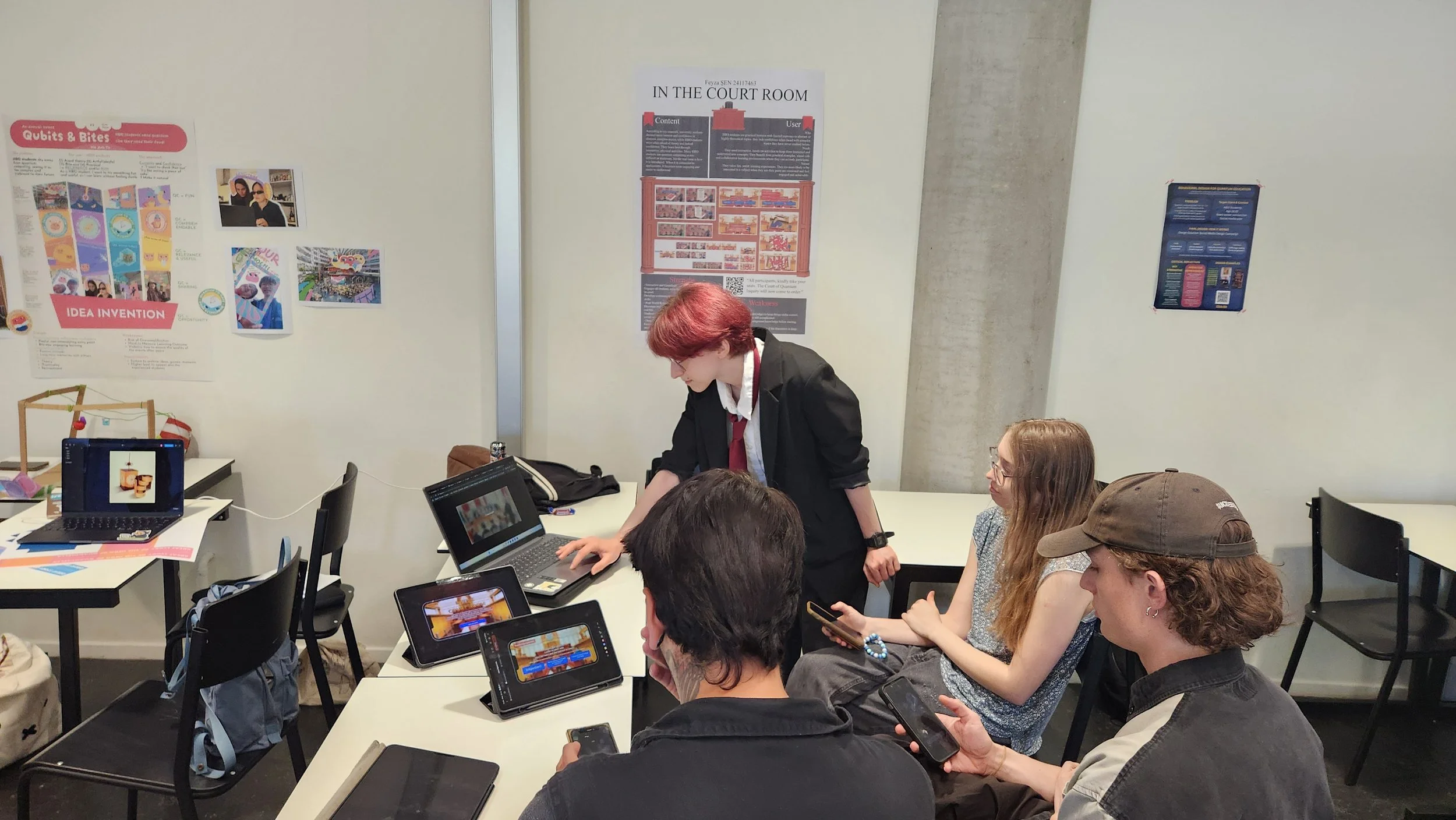
In collaboration with THUAS Civic Technology research group, I guided 17 first-year UX design students throughout the overall 8-week design process as a lecturer, supporting the delivery of student outcomes.
This project was intentionally designed as an iteration of the 2024 Quantum Inspire course. Rather than restarting from scratch, I focused on improving scope clarity, research validity, and measurable outcomes based on lessons learned from the previous year.
The 2025 edition represents a refinement phase rather than a new initiative.
Context
The 2025 edition represents a refinement phase rather than a new initiative.
In collaboration with THUAS Civic Technology research group, I guided 17 first-year UX design students throughout the overall 8-week design process as a lecturer, supporting the delivery of student outcomes.
This project was intentionally designed as an iteration of the 2024 Quantum Inspire course. Rather than restarting from scratch, I focused on improving scope clarity, research validity, and measurable outcomes based on lessons learned from the previous year.
Problem Definition
As a lecturer, reflection on the previous iteration revealed two major issues:
The target group was too broad (“students” vs “tech-minded citizens”), reducing design focus.
Limited research participation weakened insight validity and measurable outcomes.
>> Together with the client, we refined the project scope to focus specifically on HBO students.
As a designer, early word-cloud exercises showed that students associated quantum computing with confusion and complexity.
Quantum computing remained intimidating and abstract for students.
Background
Quantum Inspire is a Dutch cloud-based quantum computing project, funded by the NWO, that expands public access to quantum technology.
The collaboration with THUAS Civic Technology research group aimed to seek ideas on how to increase students’ awareness of quantum computing.
Key Observations from 2024

ideation
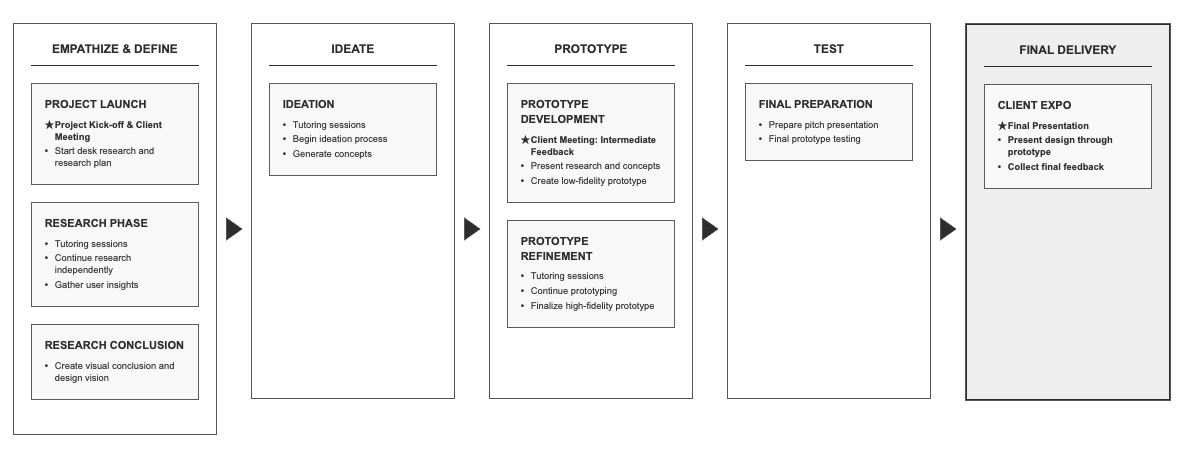
The students went through ideation for 3 weeks. They were guided to conduct 1-2 iterations based on feedback.
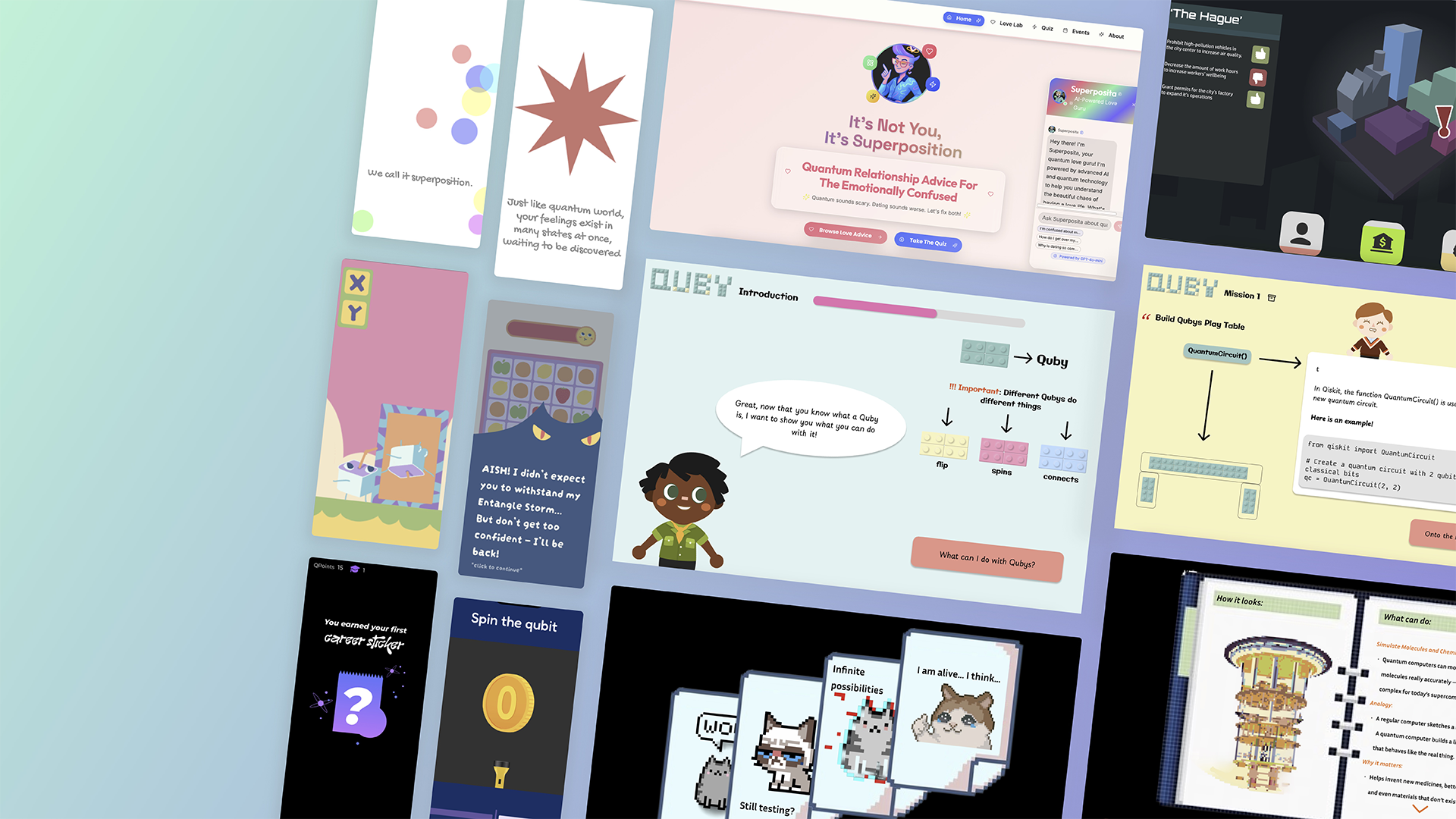
16 outcomes were created. The bar graph shows which key strategies from the given design challenge were applied.
Overview: Design Directions
Final Design
direction 1
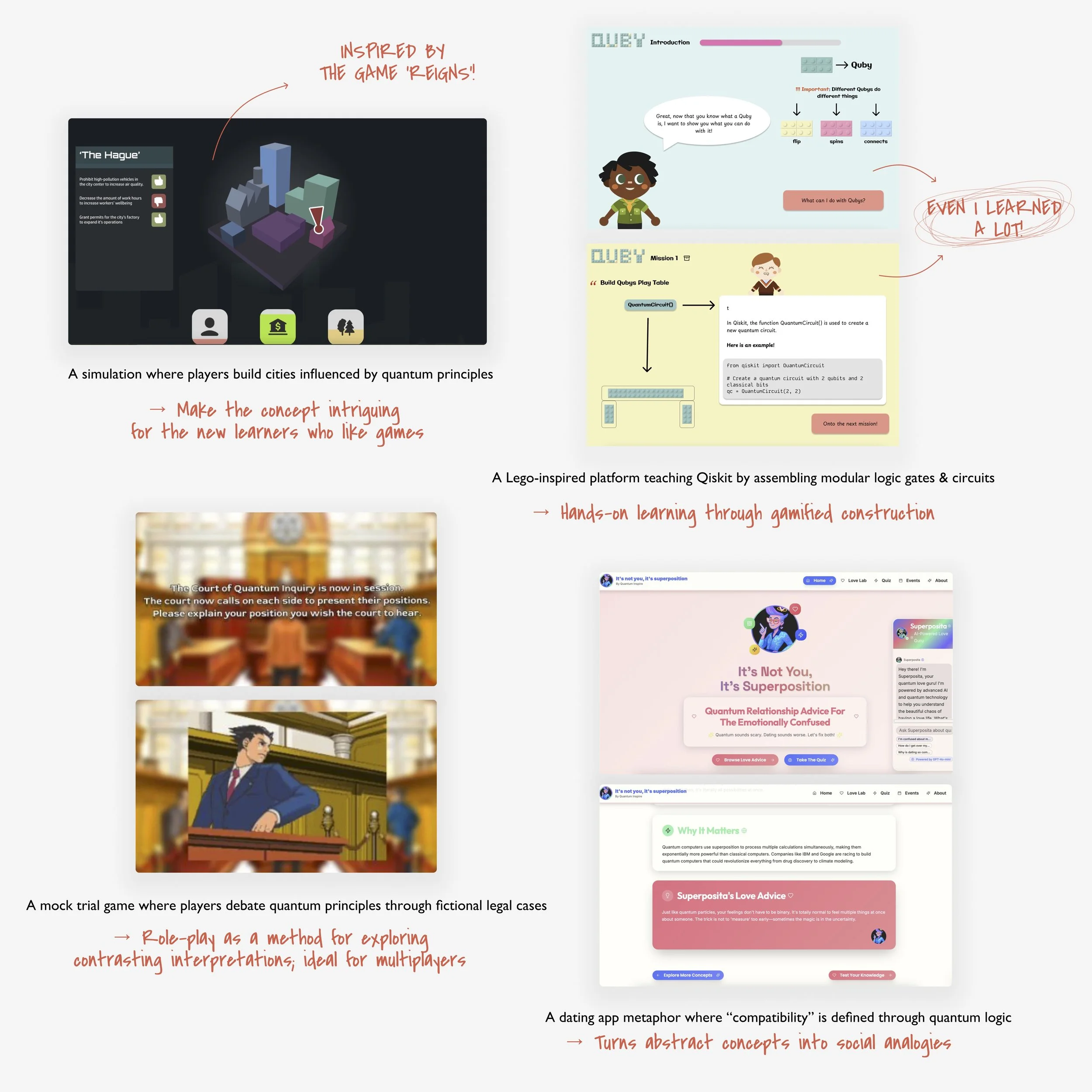
Game & Interactive Experiences
Some students converted complex quantum concepts into play, simulation, or interactive storytelling.
For this direction, I mentored students on applying interaction design principles and media-based storytelling to build intuitive and engaging learning formats.
Key Characteristics
Systems Thinking through Play
Learners engage with interconnected variables, consequences, and decision-making, especially in simulation and choice-based formats.
Embedded Learning Mechanics
Concepts are internalised not through explanation, but through gameplay itself, learning by doing, not reading.
Role-Playing for Perspective Shifts
Many concepts place users in a character role (e.g., office worker, judge, gambler), promoting empathy and engagement.
Replayability & Outcome Variability
Scenarios often allow for multiple outcomes or paths, encouraging repeated play and deeper understanding through iteration.
direction 2
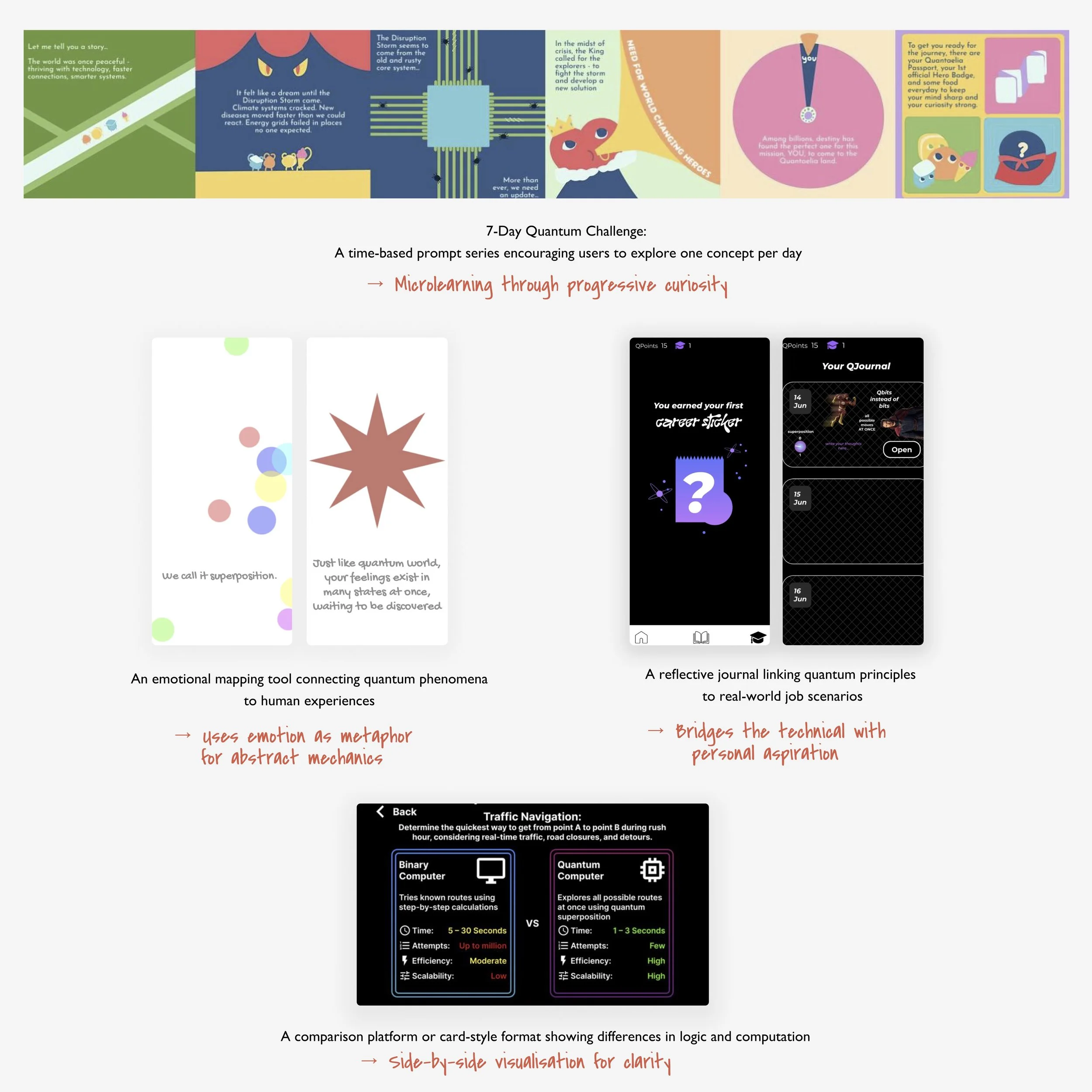
Exploratory & Reflective Concepts
Other students came up with experiences that focused on content creation, storytelling, emotion, or education through metaphor and community.
For these ideas, I mentored students on applying information hierarchy and media theory to build intuitive flows and reflective engagement.
Key Characteristics
Metaphorical Framing
Quantum concepts are translated into emotional, cultural, or personal metaphors (e.g., journaling, dating, art), allowing intuitive access.
Personal Relevance & Self-Discovery
Users reflect on their identity, behavior, or daily life through the lens of quantum ideas (e.g., personality test, daily challenge, pattern generator).
Narrative as Explanation
Information is conveyed through storytelling rather than instruction; emphasising emotion, pacing, and tone.
Cultural and Social Contextualisation
Platforms like TikTok or creative design tools ground quantum topics in current media cultures or community-based expression.
reflection
Change in Understanding towards Quantum Computing
During the course, I asked the students to self-assess their understanding of quantum computing, which is the central focus of the Quantum Inspire project.
The results indicate that the activities, projects, and instructional design were effective in making complex quantum concepts accessible and engaging for a non-technical audience. (Scale: 0 to 10, n=15).
6.07
after
3.65
Before
as a lecturer
Compared to last year, I felt significantly more confident guiding this project, having actively deepened my understanding of the topic through various events and learning opportunities.
As a result, each concept explored in the course went beyond surface-level definitions and engaged with ideas like superposition, entanglement, and qubits in a way that offered greater clarity and relevance. We made a conscious effort to ensure these abstract concepts were not only accurate but also relatable to the students. I also observed a marked improvement in the diversity and depth of the ideas developed.
In the end, the client rated the quality of student outcomes a perfect 10/10.